
Visiting Jane Austen
What did she look like, and why do we care?

As my cousin Jane and I approach the village of Chawton in her fast, red, open-top-car, I plead for time out. We haven’t seen one another in a long time and I’m straining to hear all the gossip over the roar of the wind and the highway. Jane is blonde and sleek and tan and has polished red nails to match the enamel of her car. She and the BMW draw admiring glances from men in plainer cars, who make a point of overtaking us. Over on the passenger side, I have a sunburnt forehead, ink-stained fingers and hair in my mouth. We are very different, Jane and I, but we share history and genes and a connection to Jane Austen, and I am delighted to be spending the day together. I am eager to hear about the family members I barely know and those I love dearly, the rumored pregnancies of distant cousins and the confirmed ailments of our elders, but I pause the conversation as we approach the village because I want to quietly retrieve the image I have held in my mind these past months of Jane Austen’s home. I want to project the image like a slide, superimpose it over the actual view and catch that elusive transition when the sight I have imagined shimmers and dissolves into the reality before me. I always conjure an image of a place or person I have not yet seen, which rarely aligns with the real thing. I long to catch the split second they both exist. I never succeed. This time the car is too fast and the approach too quick and “there” becomes “here” and I miss the moment. Again.
Jane Austen would have driven along here in an open-top-vehicle too, but it would have been slow and quiet and she would have been sensible enough to wear a bonnet.
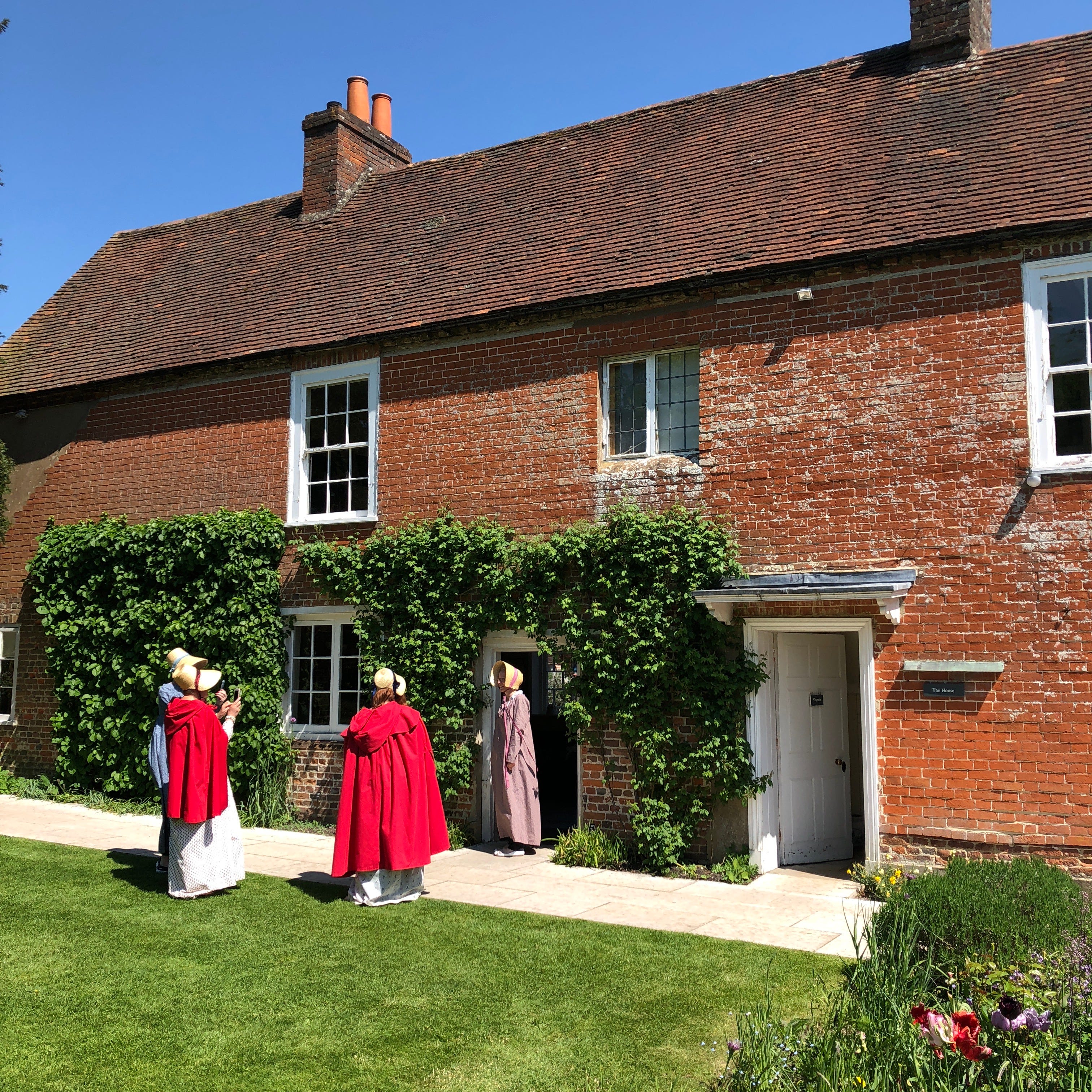
We are standing across the road from the house. For a moment I think I’m dreaming. The door opens and a young woman in a red cloak and bonnet steps out. Four others emerge one by one into the garden. We can see them over the low wall as they laugh and hitch up their skirts and hold their bonnets in the breeze, for all the world like Lydia, Kitty, Mary, Elizabeth and Jane Bennet. And then they take out their cell phones and pose for photos.
I take out my own phone to remind myself who I’m meeting and which entrance to use.
I had written to the Jane Austen House Museum several weeks ago but had still not received a response when I arrived in London on a red eye from New York. I went straight from Heathrow to dinner with my uncle and aunt in Putney. After a lovely evening, my aunt excused herself and my uncle and I retired to his study to look up the Blackall family tree. It was close to midnight and the combination of jet lag and wine had me swaying on my feet. My insomniac uncle, on the other hand, was full of beans. With a few clicks he had us climbing down our family tree from spindly, familiar twigs to the great ancient trunk. Except there’s not just one trunk, there are many trunks. Our roots unfurl and overlap and become one enormous, underground tangle supporting many trees, like the Trembling Giant in Utah, the massive clonal colony of shaking aspen that is possibly the largest, heaviest and oldest organism in the world.
Look, he says. If we go this way, and take a left over there, then follow the French for a couple of centuries, and pop back over here, we can trace our way to Henry III!
But it’s not Henry III that Laurence wants to show me.
Here, he points, is a man called Bridger Steward.
Bridger Steward was Edward Knight’s bailiff.
He lived in Chawton Cottage with his wife and daughter until his death in 1808, after which Edward Knight gave the cottage to his own mother and his sisters, Cassandra and Jane Austen.
Bridger Seward’s daughter was also called Jane.
She married William Blackall.
Jane Blackall was your great-great-great-great grandmother.
Wait.
Wait. Wait. Wait.
MY GREAT-GREAT-GREAT-GREAT-GRANDMOTHER LIVED IN JANE AUSTEN’S HOUSE??
Back in my Covent Garden airbnb, wide awake at 2am, I check my inbox to see if I’ve heard from the Jane Austen House people. Nothing.
I resend my original email with a casual post script. “Incidentally, my great-great-great-great-grandmother…”
I wake to a warm reply from the curator, which ends “With best wishes, and looking forward to welcoming you ‘home’!”
And so here we are, standing across the road from Chawton Cottage, watching young women in period clothes take selfies on their phones.
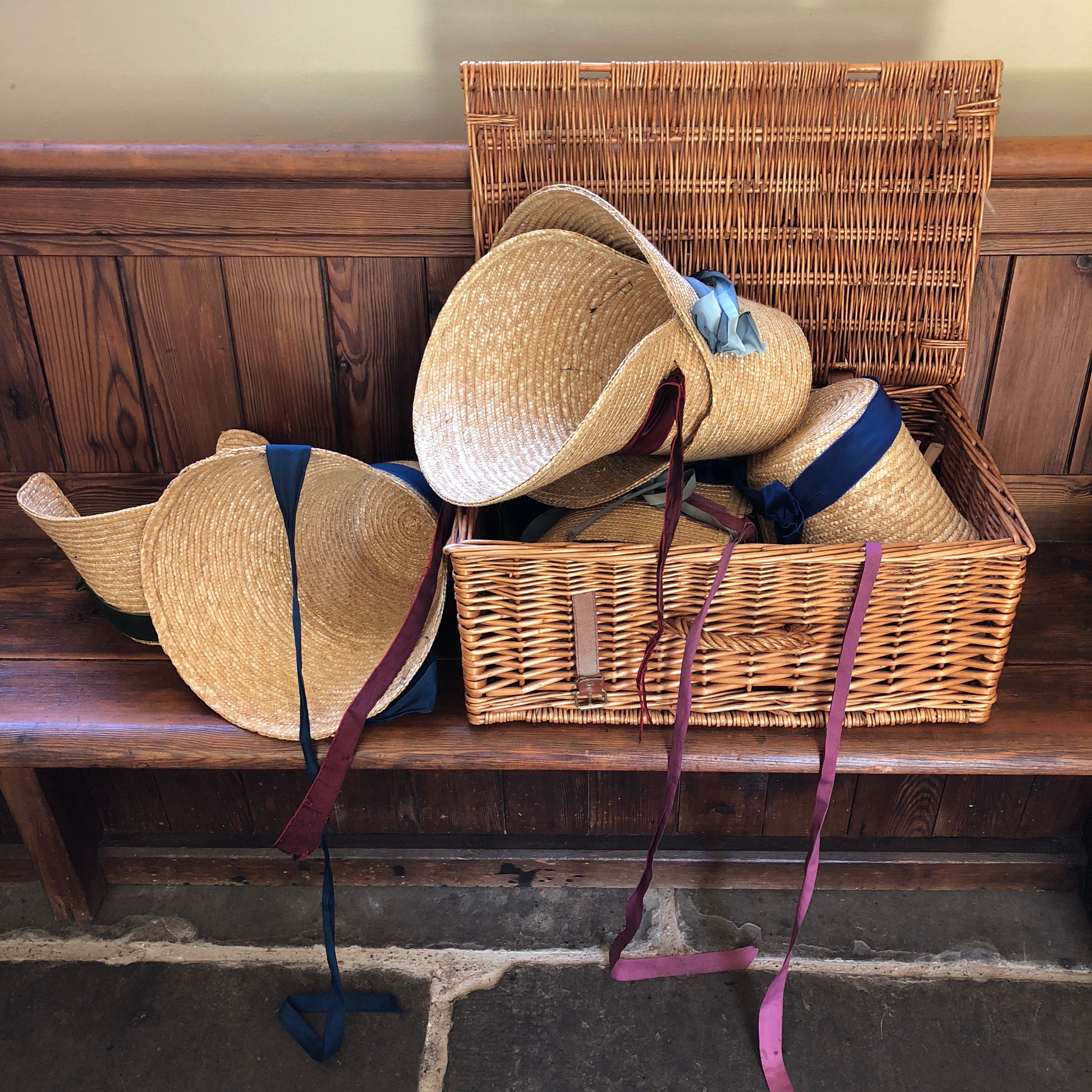
By the time I meet with the curator, Mary and today’s volunteer docents, Maria and Marian, and begin to explore the house, the young women have evaporated, leaving behind cloaks, muslin dresses and straw bonnets on pegs in the old kitchen.
The kitchen offers visitor activities. You can dress up, make lavender bags with cheese cloth and string or write a letter with ink and a quill.
Dozens of ink-splattered letters in script are pinned to a board on the wall. Many are addressed to Jane herself, effusive expressions of gratitude and admiration and love, some rate the facilities, and one proclaims in incongruous capital letters, “BEN SIMMONS IS NOT A ROOKIE,” which, as Ed explains to me later, in too much detail, refers to an NBA player.
There are a few people entering the house at the same time, so I linger to give them a head start. I chat to the docent Marian, who is reading a large print book.
It’s Pride and Prejudice.
“Somehow I never got around to it!” she laughs. “My daughter read it. She was disappointed Mr Darcy didn’t come out of the lake. I haven’t got to that bit yet.”
I envy Marian reading Pride and Prejudice for the first time. I tell her I was ten when I first read the book, under a mosquito net in Fiji, eating shards of coconut, the pages curling in the humidity.
“Fancy!” she says.
The party ahead of me has moved on so I enter the living room.
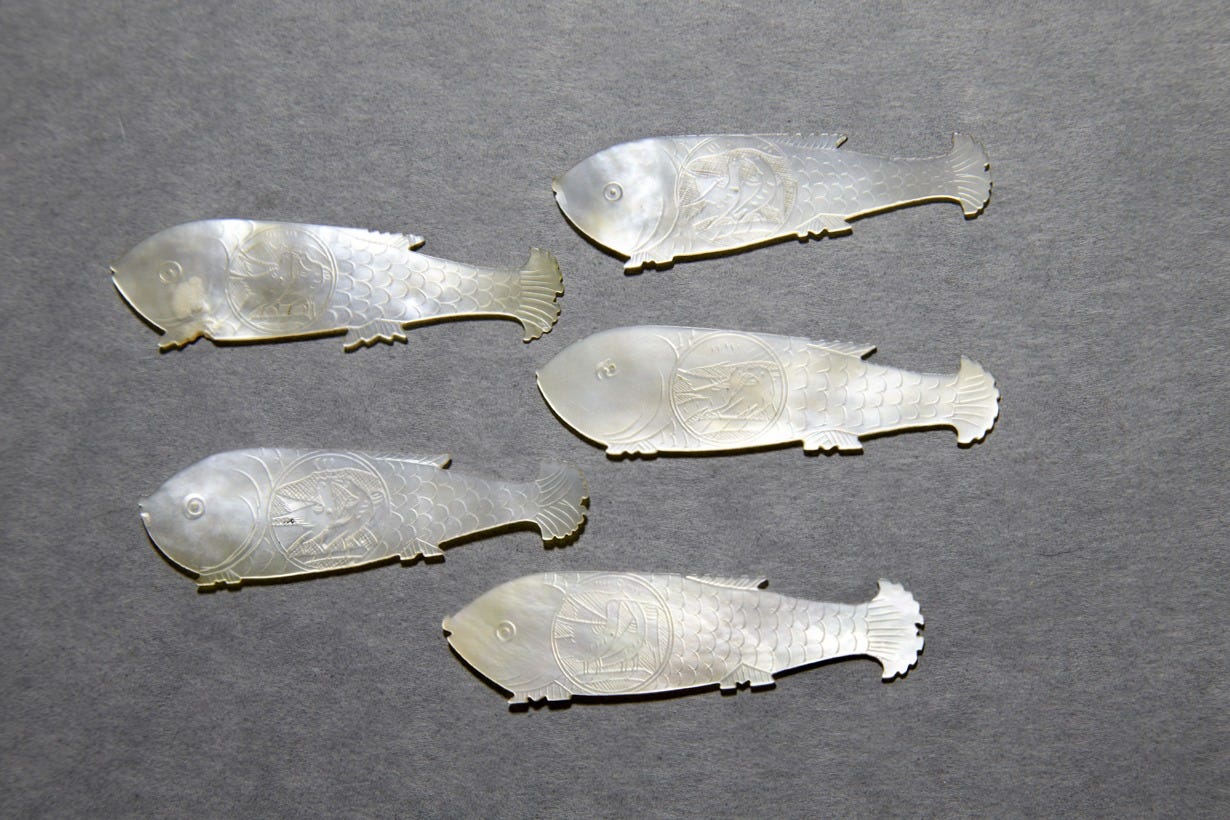
Jane lived in this house for the last eight years of her life, with her mother, her sister, Cassandra, and their friend Martha Lloyd. Together they received visitors and played “spillikins,” “conundrums” and “lottery tickets,” betting with little mother-of-pearl-fish. They read and wrote letters and no doubt discussed rumored pregnancies of distant cousins and the confirmed ailments of their elders. They played the piano, and entertained each other with stories and poems and jokes. Together they worked on a meticulously-pieced-patchwork quilt. Quietly they toasted cheese and fretted over money. It was here that Jane darned stockings and copied out recipes and, now and then, made her own ink. It was here that she wrote and revised her six novels.
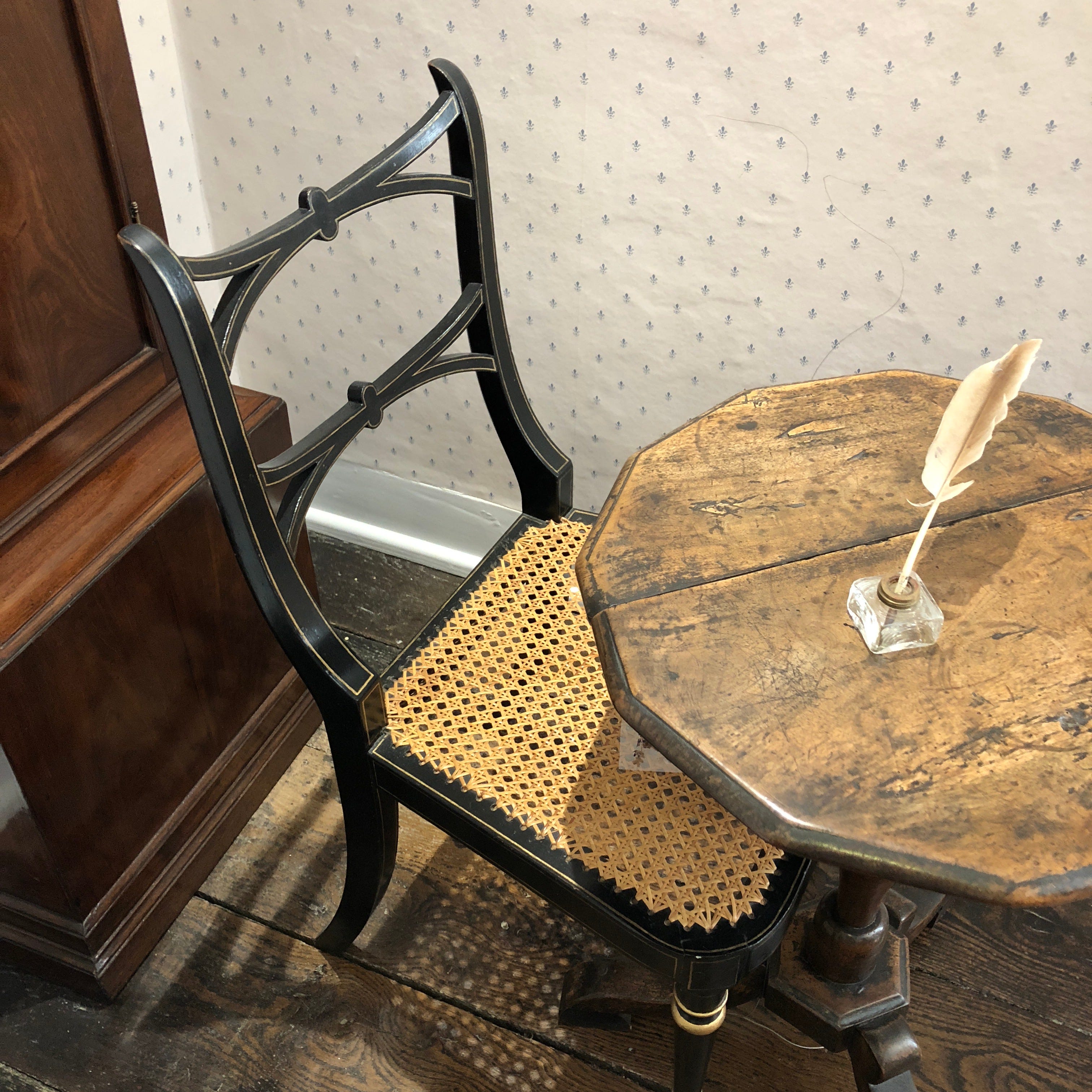
Jane’s writing table stands under a window in the dining room. It is a small, wobbly walnut table with tripod legs. I am a person whose chaos spreads over several tables and spills onto the floor and I can’t imagine how she was so contained. Her nephew James Edward Austen Leigh described in a memoir how she was adamant that no-one other than her close family should know that she was writing books, and that she wrote, “upon small sheets of paper which could easily be put away, or covered with a piece of blotting paper.” So not only did she write on a tiny table, she did so discreetly, suffering constant interruptions. She was very rarely alone, and as an unmarried woman, she was often expected to travel to the bedside of ailing aunts or cousins in confinement, who required her services. Even when home, she shared a bedroom with Cassandra. But somehow, in those eight years, she completed Sense and Sensibility, Pride and Prejudice, Mansfield Park, Emma, Northanger Abbey, and Persuasion. With home made ink.
I am excited to find the ink recipe on display in Martha Lloyd’s Household Book in a glass case towards the end of the house tour. In my own work I use Chinese ink and I like to grind the ink stick by hand on a stone with water. It’s a pre-painting ritual that allows me to slow down and gather my thoughts. It’s a time of shimmering possibility, before the image I see in my head is transformed by the limitations of my hand on the page. I like to imagine Mr Collins or Lady Catherine de Bourgh taking shape in Jane’s head as she followed the recipe:
Take 4 ozs of blue gauls, 2 ozs of green copperas, 1 1/2 ozs of gum arabic, break the gauls, the gum & copperas must be beaten in a mortar and put into a pint of strong stale beer; with a pint of small beer, put in a little refin’d sugar, it must stand in the chimney corner fourteen days and be shaken two or three times a day.
I decide to make this ink. I convince myself that following the recipe step-by-step will bring me closer to Jane Austen. That somehow, by making the same ink, I’ll discover something true about who she was. I copy down the recipe. Sugar is straightforward, and small beer is simply low-alcohol beer, so that part will be easy enough. Green copperas is iron sulphate, which I will order online, along with some gum arabic. The blue galls, I learn, are oak apple galls, which are the spherical growths made by wasps on certain oak trees, none of which grow anywhere near New York. I’ll find them on a website which also offers snake eggs, potions and spells. Curious, I will dig a little deeper to read that oak galls are used by some women to tighten their vaginas after childbirth. The internet is full of sites selling galls, promising amazing sex, and others, with crying vagina emojis, imploring women not to insert wasp nests up their woo-woos. I will back slowly out of the room.
When my witch-blessed galls arrive weeks later, I will have all the ingredients, but I will struggle to find myself with 14 consecutive days near a chimney corner. It seems it won’t be the ink that will connect me to the author, after all.
Iron gall ink can be extremely corrosive, so it is something of a miracle that Austen’s manuscripts and letters have survived. Well, some of the letters survived. We know that Cassandra burned many of Jane’s letters in 1843 and of the ones that remain, lots have sections cut out. Much has been written about the missing letters and paragraphs. The known unknowns and the unknown unknowns. There is endless speculation about everything concerning Jane Austen—was she or wasn’t she a feminist? Was she deeply concerned with social issues of her day, hinting at her political leanings between the lines of her novels, or did she actively avoid current events, concerning herself only with “three or four families in a country village,” the kind of plot she favored? Was she pretty or plain? Was she queer or straight? Was she was ever in love? How could someone who wrote about love with such deep insight and sensitivity not have been in love herself? Books have been written and movies have been made speculating on Jane’s romantic adventures. There was a youthful flirtation with Tom Lefroy, the Irish nephew of a family friend; an extremely brief engagement to poor Harris Bigg-Wither, six years her junior, which lasted only a day as Jane changed her mind the following morning; and a mysterious seaside affair with a handsome clergyman, who some consider the lost love of her life, and who has been identified as one Samuel Blackall. (I could tell you how we are distantly, distantly related, but it would involve climbing back up my uncle’s family tree and we’d be here forever.) Seeing as Jane’s letters to her sister are often written tongue-in-cheek, we can’t really know how much to trust her flippant mentions of romance. And if we can’t trust Jane, we certainly can’t put too much store by the sanitized memoir written by her nephew more than fifty years after her death.
What little we know of the author comes from her books; the existing letters; the subjective, contradictory descriptions from family members; and a few precious objects on display at Jane Austen’s House that have been scrutinized and forensically analyzed, including:
The writing table, only the top of which is original.
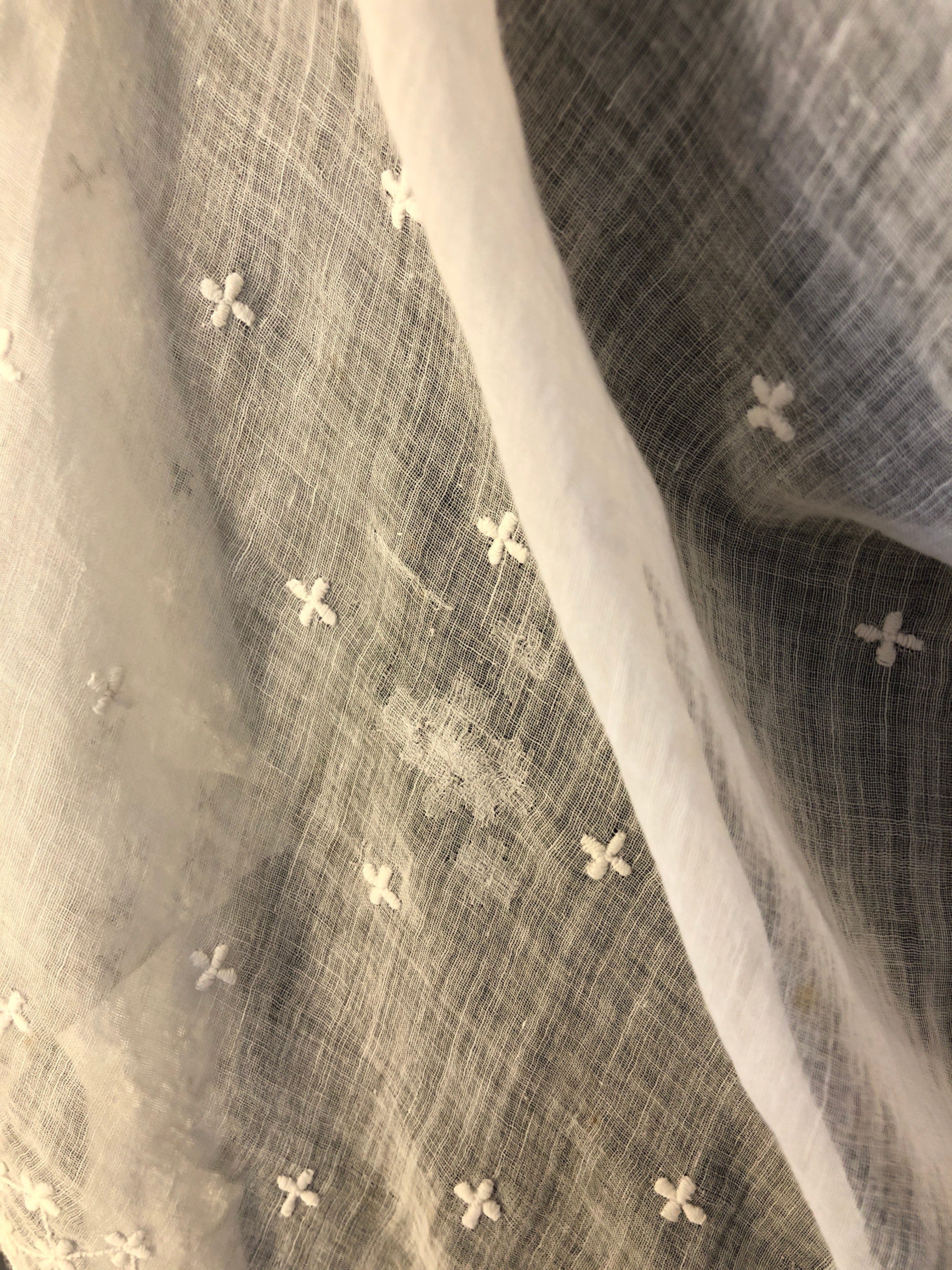
A white, embroidered shawl, believed to be Jane’s own work, delicate and fine, with endearing tiny darns.
A lock of her hair that may or may not contain arsenic, which may or may not explain anything about her life or death (as traces of arsenic were often found in water and medication and clothing) and may or may not be tested some day by neutron activation analysis, which would require a neutron bombarder, and there are only a few of them in the entire world, but there is one in Tennessee.
A turquoise ring, that was passed down through the Austen family, put up for auction by Sotheby’s in 2012, bought by the singer Kelly Clarkson for $250,000 (several times the reserve price), and which was prevented from leaving the country in a last minute national uproar, the culture minister deeming the ring a “National Treasure,” straddling it with an export ban, and giving Jane Austen’s House Museum time to raise the money to buy it from under Clarkson, which it did.
This whole ring business incited trans-Atlantic shaming across the Jane Austen discussion boards:
Shame on Austen’s descendants for selling the ring.
Shame on them for keeping it in a drawer all these years.
Shame on Kelly Clarkson for trying to steal a national treasure.
Shame on the British government for deciding it was a national treasure only after Kelly Clarkson bought it…
But most people agree Kelly was nice about the whole thing and gave it up without a fuss. She even had a replica made which she wore when she sang at President Obama’s inauguration.
After the dust settled and the ring found its way back to Chawton, some brave bloggers wondered if it had been worth all the fuss. After all, it is just a ring. A relatively plain ring. Jane Austen doesn’t mention it in any of her letters or stories. We don’t know how she came by it and until relatively recently we didn’t even know it existed. It doesn’t tell us anything new about the writer. We assume she wore it, but that’s about it.
Which brings us to…
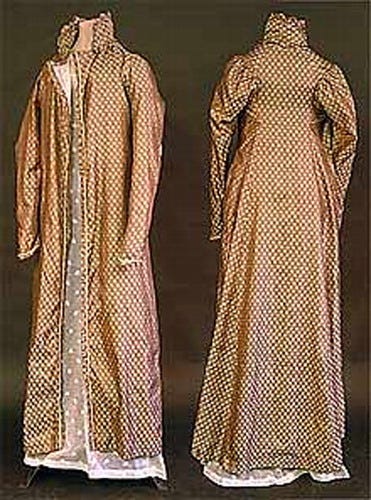
A brown silk pelisse. A pelisse is kind of a coat and kind of a dress, worn long, with sleeves, sometimes cut away at the front to reveal another dress beneath, sometimes worn with a belt made of the same fabric. The pelisse on display in the house is a replica, made
by Hilary Davidson, a fashion historian who painstakingly analyzed the original, determined to find every fiber of information about its wearer, and whether or not that wearer might have been Jane Austen. (There is mention of a silk pelisse in a letter to Cassandra! We know Jane liked the color brown! She was, at this time in her life, making some money from her books and could afford the fabric! Why else would it have been kept so long?) Assuming it was Jane’s pelisse (we will never know for sure), Davidson was tasked with drawing conclusions about the author’s figure, and even, from the stress of the coat’s seams, the particulars of her gait. Davidson commissioned reproduction fabric, a warm brown silk twill woven with a pale gold oak leaf motif, she used reproduction silk twist embroidery thread, and a number 12 Sharp needle and matched the stitches, nine per inch. She took the finished replica to a Jane Austen Festival in Canberra, Australia and looked for a person who might be the right size to try it on, testing it on people with smaller and smaller proportions. She found the pelisse fitted a thirteen year old perfectly around the torso, but was too long and dragged on the ground. Finally she found a sixteen year old called Jupiter, who was the Cinderella in this scenario. After months of research and exploration and interrogation and fabrication, the conclusion was that if this pelisse did indeed belong to Jane, we now know she had a 31-33 inch bust, a 24 inch waist, 33-34 inch hips, and was between 5 feet 6 inches and 5 feet 8 inches tall. As Davidson notes, the only way to actually corroborate this would be to exhume Austen’s body and measure her skeleton.
The obsession with Austen’s appearance basically comes down to: Was she hot? And if not, that (apparently) explains why she didn’t marry and became a writer, but if she was, then it’s a win for women everywhere. The thing is, we don’t really know what she looked like.
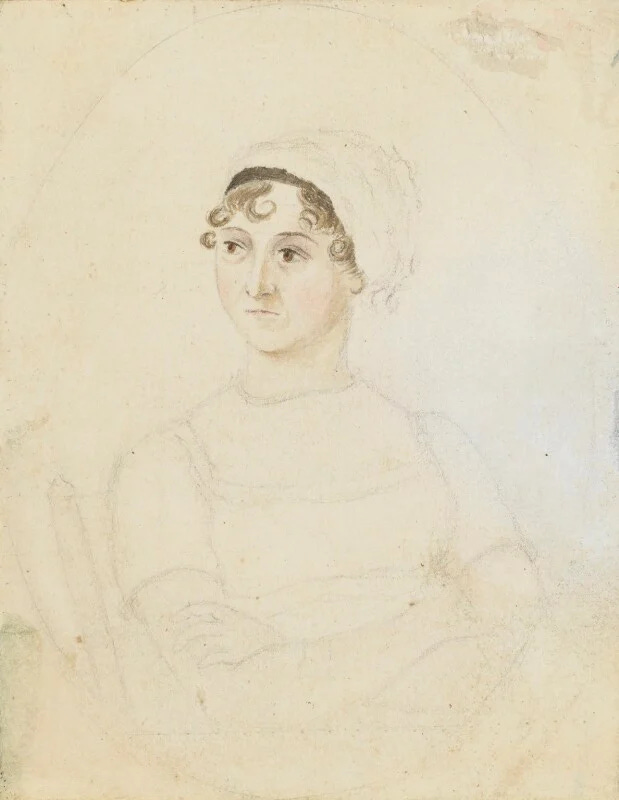
The only authentic portrait of Jane Austen made in her lifetime was a pencil and watercolor sketch done by her sister, Cassandra, in around 1810, which Jane’s niece Anna Lefroy later claimed was “hideously unlike” her. The sketch is on display in the National Portrait Gallery in London, is visited by thousands of people every year, most of whom seem to leave disappointed. This is not the Jane they imagined. She looks grumpy and tired, her eyes skeptical, her mouth a little mean. Where is cheeky Jane? Bold, lively, humorous, curious Jane? Cassandra’s drawing was the reference point for a second portrait made to accompany her nephew James Edward Austen-Leigh’s memoir in 1870—this revised portrait is a sentimental Victorian makeover, with soft eyes, full mouth and rosy cheeks. The more palatable Jane graced a new ten pound note on the 200th anniversary of her death, but most Austen scholars dismiss the likeness as a fantasy. Readers yearn for a formal portrait made in Jane’s lifetime, as there are for all but one of her brothers. They want her to have been valued enough by the men in her family (who controlled the money) to record her likeness. Every so often a new possible portrait surfaces, creating ripples of excitement. The validity of each contender is vigorously and rigorously debated, it is added to the collection from which we attempt to form a composite, to furnish ourselves with an image that more solidly resembles the shimmering one in our heads. But by and by, we return to the dashed off sketch made by the person who knew and loved Jane Austen best in the world. I feel a great fondness for Cassandra’s wonky sketch.
When my husband and I first separated, it was very lonely but after a while I was embraced by a group of artists and writers, film makers and archivists, who were parents of my children’s friends. We lived a few blocks from one another in Brooklyn, and we would gather on weekends for drawing and potluck. The kids would draw with us and if they didn’t want to, we would make them sit still so we could draw them. Those children are all in their 20s now, but between us there are sheaves of sketches documenting their—and our—younger selves. My drawings were mostly terrible and “hideously unlike” their subjects, but they represent collective hours in happy company, where a group of friends looked carefully at each other with love and curiosity and respect.
We don’t know what Cassandra thought of the sketch she made, but we do know how she felt about her sister. When Jane grew very ill, Cassandra rarely left her side. Jane Austen died around dawn on the 18th of July, 1817, her head cradled in her sister’s lap. “She was the sun of my life,” Cassandra wrote, “the gilder of every pleasure, the soother of every sorrow. I had not a thought concealed from her, and it is as if I had lost a part of myself.’”
Cassandra drawing Jane, whatever the limitations of her hand upon the page, was an act of love.
Mary Oliver once wrote, “how could these makers of so many books that have given so much to my life — how could they possibly be strangers?”
The answer is that they’re not, but also that they are. We project whatever we like onto the writers whose books we love, just as we read whatever we wish into the books themselves. I have read Jane Austen over and over since first opening Pride and Prejudice as a ten year old, with the sound of waves crashing outside our island hut. I have read her as a curious child, a self-conscious teenager, an uncertain college student, a young mother, a middle-aged writer. I prefer to think she was a feminist, that she was keenly aware of and frustrated by the oppression of women, that she knew about her father’s connection to a sugar plantation in Antigua and that she supported the abolition of slavery. I also think the social interactions of three or four families in a country village can be profoundly interesting. I don’t care if she was pretty or plain, queer or straight, but I do hope that she felt loved. I find something new in Jane Austen’s books every time I read them, and like millions of people all over the world, I feel a deep connection to their author. Even more so having visited her house. Jane Austen may be a shimmering enigma, but her books are real and her readers are real and her house is a place that brings us all together. It is not because of the floors upon which she stepped, or the walls that absorbed her voice, or the little desk, or the contested ring, or the reproduction pelisse. It is because of the earnest ink-splattered letters of gratitude pinned up in the kitchen, and the delighted young women dressed up in long skirts and bonnets on the lawn. It’s the volunteer docents sitting in the garden eating sandwiches out of Tupperware containers, discussing what Jane Austen might have thought of Harry and Megan. It’s the students at Wellesley College who staged the first known performance of Pride and Prejudice, with an all female cast, in 1899, and the Janeites gathering at future festivals in Canberra, or Florida, or Bath. It’s the soldiers who read Persuasion in tents in WW2, it’s the signed excerpt from Winston Churchill’s wartime memoir, hanging upstairs in Jane Austen’s House, in which he describes receiving great comfort from Pride and Prejudice when bedridden with pneumonia. It’s my cousin Jane, who has visited this house many times before, once as a child with our grandmother, and it’s our grandmother who knew Mansfield Park almost by heart, and who stole, as little Jane watched, a small sprig of myrtle from the garden, which grew into a large bush, that for all I know grows still and might outlive us all. And it’s Cassandra, who outlived her sister, who was loyal enough to keep her secrets, who once attempted to sketch her portrait.
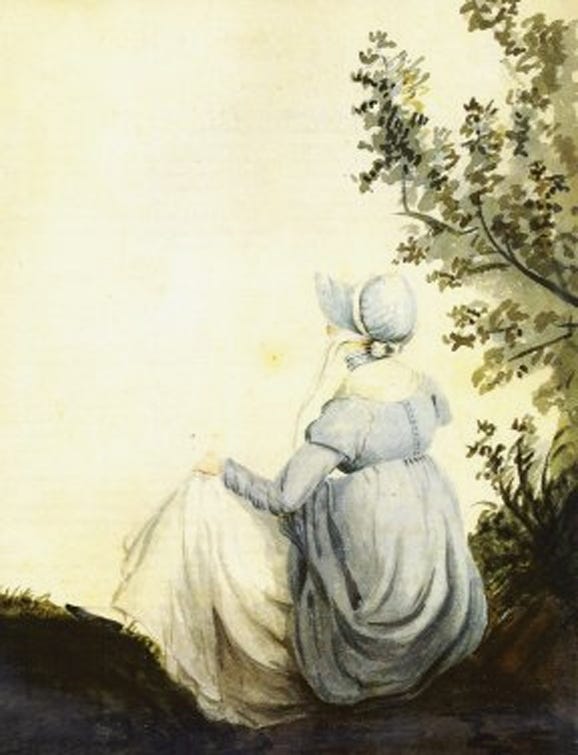
There is another drawing Cassandra made of Our Jane. We see her from behind, sitting on a hill, one leg bent, her hand on her knee. Her back is straight, her bonnet strings are loose and she looks ahead at an open expanse. We can almost imagine at any moment, she might turn around and laugh at us. I see her right there, shimmering, in the in-between moment when anything and everything is possible.
What a delight! Thank you, Sophie and happy birthday, Jane!
I enjoyed reading your story and your connection to Jane Austin